

Interactive
System
Interactive systems specialised in generating sound/music based on algorithms or reacting to movement, scenery, color, etc. Now discontinued.
Listening to Movement
A camera detects movement and transforms it into sound. It makes sound only when something is moving, and the pitch and volume depend on how fast it moves. It is a good idea to use it for dance which enables the dancer to adapt sound/music for a dance - the opposite of common ways. You do not need anyone to play sound/music as the system runs automatically.
Listening to Scenery / Light
A camera detects objects and transforms them into sound. It makes sound only when there is/are object(s), and the tone and volume depend on color and brightness of every object. The bigger the object is, the lower the sound becomes. It is a good idea to use it for the scenery seen from a train/vehicle window or a boat traveling on a river.
Audible Virtual Biosphere
Binaryosphere is a software that emulates "nature (an ecosystem)" - sound of rain, wind, waves, waterfall, thunder, and imaginary creatures reacting to the movement of people as well as according to time, temperature, humidity of the day, and seasons - which means the sound will be always different, just like real nature.
It runs anywhere there is a macOS or Windows computer with speakers and a camera(s) connected. At your shop, school, office, on stage, home - wherever you want. Every sound is generated by internal synthesizers and no recording is used.
Physical-activated Step Sequencer
Miohata is a software that turns something such as a wall or a table into an instrument. By recording a sound of any object around you and placing it on a cell of a table, Miohata recognises the object and starts making sound as a light belt comes along with the sound you have just recorded. Miohata has several tracks that can deal with different sounds at different times.
The word "Miohata" stands for "320" in traditional Japanese math - there are 320 cells consist of 2 bars of 16 beats when divided by 10 tracks. It runs anywhere there is a wall or table, and a macOS or Windows computer with speakers and a camera(s) connected. At your shop, school, office, on stage, home - wherever you want.
Acoustic Simulator for Disaster Warning System
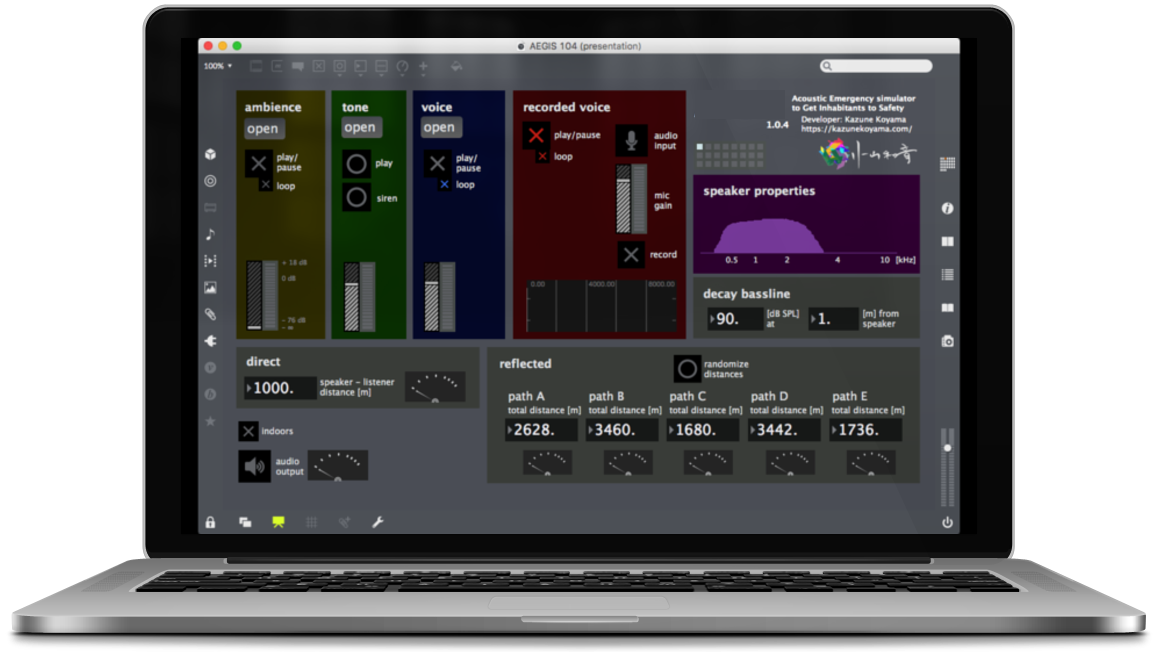
This is a software aimed at training disaster warning announcement which reproduces what listeners (people evacuating) actually hear by simulating speaker properties, decay, reflection, ambience, and being indoors.
There are disaster warning systems for each local area in Japan, which does not really reach the inhabitants sometimes because of being far away from the speaker, being indoors, lots of reflections caused by buildings and mountains, and some noise such as rain or construction works. But it is known that changing the way the announcer speaks will improve conveying more accurate information and save more lives from disaster. To make it possible, the first thing is to know how the inhabitants actually hear the announcer's voice, which the simulator is aiming for.
- Choose and play a background soundscape (rain, construction works, etc.)
- Choose and play a single tone (chime, etc.)
- Play a siren
- Choose and play announcement recording
- Record and play announcement
- Set a frequency property of a simulated speaker
- Set a baseline of decay simulation (distance from the speaker [m] and sound pressure level [dB SPL])
- Simulate delay of direct sound from the speaker to the listener
- Simulate reflection and delay caused by buildings or terrains (5 paths)
- Simulate sound while being indoors (JIS A 4706 T-1 class transmission loss)
- 2016年3月9日 日本音響学会2016年春季研究発表会 スペシャルセッション災害等/騒音振動/建築音響/電気音響/聴覚/音バリアフリー [災害等非常時屋外拡声システムに関する最近の研究動向] 発話音声分析 1-9-16 防災放送のアナウンス訓練システムの実用化◯土田義郎(金沢工大)
This system is based on the PureData patch published in the following documents, requested from Kanazawa Institute of Technology. (Japanese)
○土田義郎:防災放送の訓練システムに関する基礎的検討,日本建築学会大会 学術講演会梗概集,VOL.防火,435-436, 2013/08/30.
○土田義郎:超巨大災害発生時の避難勧告・指示の効果的情報伝達対策,シンポジウム「南海トラフ巨大災害の防災対策について」,金沢工業大学地域防災環境科学研究所,32-33,2014/09/27.
Achievements
| 14 Jun, 2019 |  Utrecht, Netherlands Utrecht, Netherlands |
Yingyi Wu | Custom-made | Reactive audio generation system for physical performances |
| 26 Jul, 2018 |  Tokyo, Japan Tokyo, Japan |
Tokyo Denki University | Custom-made | Reactive audio generation system for the research "住空間における視聴覚環境による共在性の構築とその生理心理的効果の検討" |
| 12 Dec, 2017 | Tokyo, Japan |
Tokyo Denki University | Custom-made | Reactive audio generation system for the research "住空間における視聴覚環境による共在性の構築とその生理心理的効果の検討" |
| 2 - 3 Sep, 2017 | Eindhoven, Netherlands |
Klokgebouw | Exibition | Physical step sequencer for Eindhoven Maker Faire 2017 |
| 30 Nov, 2015 | Kanazawa, Japan |
Kanazawa Institute of Technology | Custom-made | Acoustic Simulator for Disaster Warning System |
| 25 Nov - 1 Dec, 2013 | Beppu, Japan |
Beppu Tower | Exibition | Reactive audio generation system for the sound installation "呼吸する都市" |
| 19 Sep, 2013 | Uki, Japan |
(Private venue) | Custom-made | Reactive audio generation system for a video work using luminous body painting |
| 10 - 11 Aug, 2013 | Yamaguchi, Japan |
Yanaguchi Center for Arts and Media | Exibition | Reactive audio generator for Yamaguchi Mini Maker Faire 2013 |
| 26 May, 2013 | Uki, Japan |
Kosho-ji Temple | Custom-made | Reactive audio generator for a dedication dance |
| 15 Sep, 2012 | Nagoya, Japan |
Westin Nagoya Castle | Custom-made | Reactive audio generator for Art Nagoya 2012 |
| 31 Mar, 2012 | Nagoya, Japan |
Jill d'art Gallery | Custom-made | Reactive audio generator for the gallery opening reception |
About payment
PayPal (credit card): 8.7% of the item price
PayPal (bank transfer): 7.4% of the item price
Shipping: none
The rest 60%: before the end of the next month of production
If notified no later than 30 days since the delivery and initial malfunction is found: Either repair or refund is possible
If later than 30 days or no initial malfuction is found: not refundable
FAQs
A I mean a core software itself. When camera(s), speaker(s), or sensor(s) are used, they are considered to be a part of the "system".
A It is for almost everyone who needs the system such as a school teacher who is looking for a new way to teach math or science (and of course music) using sound, a dancer who needs virtual musicians for his/her performance, a restaurant manager who is trying to attract some interest by interactive music reacting to weather and season, a solo musician who needs obedient players to perform songs with - and a lot more.
A If you are able to send email with a computer, yes. The system will be simplified and works just like a software when it is passed to you.